
Appearance
How we use GitHub
We use GitHub as an issue tracker our git server to store our code and documents (like the current one).
TL;DR
- Project ≈ Building cycle
- Issue Labels ≈ Filters
- PR titles and labels ≈ Release notes
Labels
We use GitHub labels for a few purposes:
- for Issues:
- to set a type and weight of the issue:
issue-type:improvement-request ✨issue-type:bug-report 🐞issue-type:burning-issue 🔥issue-type:technical ⚙️
- to set a module to make it easy to find related issues:
module:MODULE_NAMElabels (e.g.module:payment,module:permission) - to set a technical stack of the issue (
stack:php,stack:js,stack:css,stack:frontend,stack:server admin,stack:security,stack:design) - to set status of the issue:
blocking-another-issue,blocked-by-another-issue,help wanted,duplicate,not a bug - to identify good issues for new module owners:
good first issue - to define the relation of the issue to other modules:
topic:notifications,topic:analytics
- to set a type and weight of the issue:
- for Pull Requests:
- to instruct ReleaseDrafter to prepare changelogs:
- size:
pr-size:patchfor small bug fixes or internal changespr-size:minorfor new features or changes that affect the user
- category
pr-category:fixfor bug fixespr-category:featurefor new featurespr-category:removedfor removed featurespr-category:internalanything that doesn't affect app userspr-category:skip-changeloguse this label with caution since we might lose track of important changes
- size:
- to instruct ReleaseDrafter to prepare changelogs:
Projects
Project board - is a kanban board for the current goals (sprint/building cycle/cool-down/etc.).
Example: https://github.com/orgs/InteractionDesignFoundation/projects/66
Example of a project: 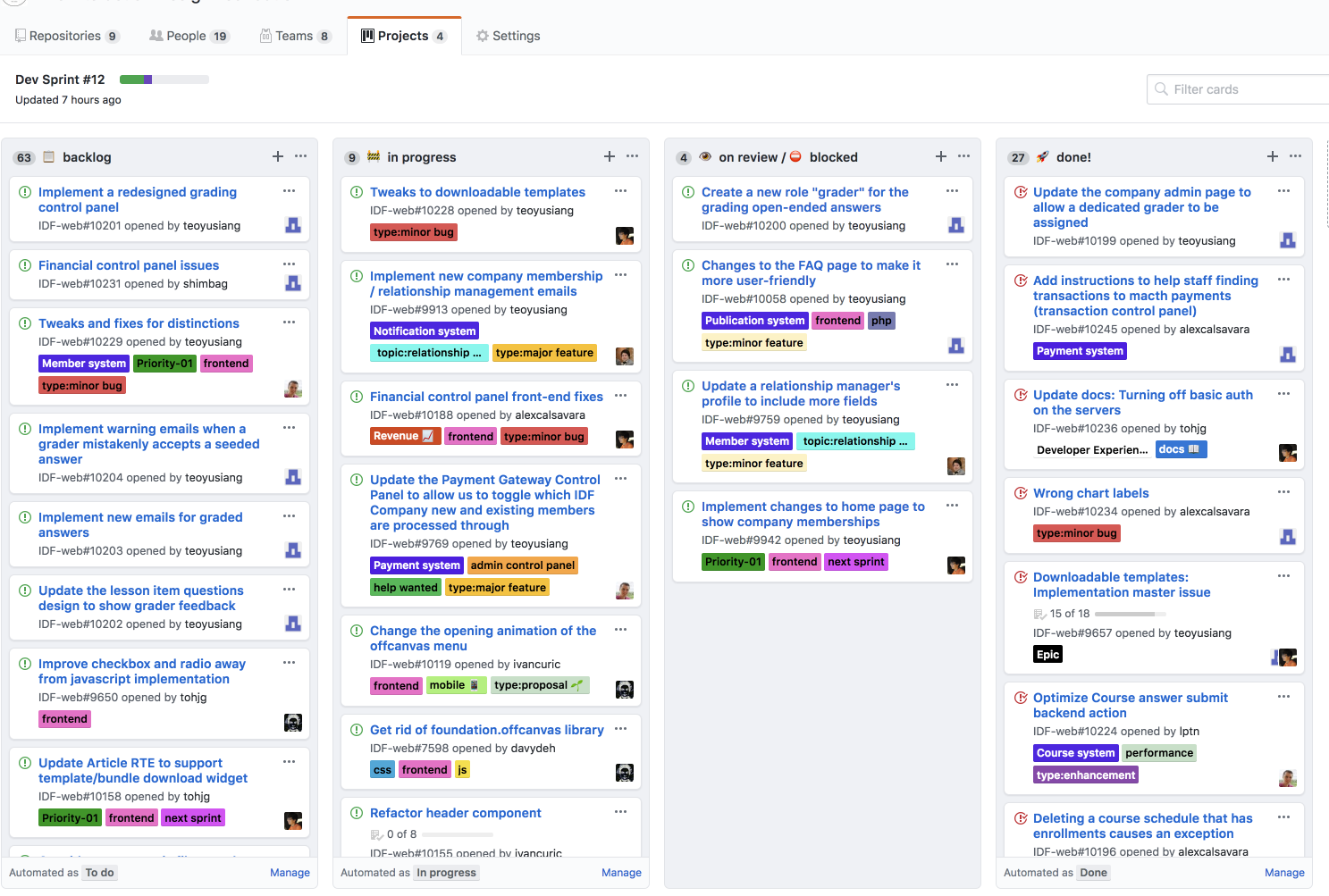
Rules for project columns
In progress
- One issue/task per developer
- If you have more than one issue in progress, it means you are either blocked or multitasking, which is not effective.
In Review / Blocked
- PRs have the highest priorities to avoid merge conflicts and allow developers to be in context on next review rounds.